Cross-Mounting in Extensive Prosthetic Rehabilitation: Why Provisionals Deserve to Be Taken Seriously
Introduction
In extensive prosthetic treatments — especially when both arches are involved in the rehabilitation — one of the greatest challenges is preserving the occlusion, the jaw relationship, and the esthetics throughout the course of treatment.
The cross-mounting technique (Cross-Mounting) was designed for exactly this purpose: using the provisional of one arch to fabricate the definitive restoration of the opposing arch, so that the jaw relationships and the occlusion are not lost.
️ What does cross-mounting mean?
In simple terms, cross-mounting means this:
After adjusting the provisionals of both arches, we take one of them as the reference (for example, the maxilla).
Then, when fabricating the definitive crowns for the mandible, we use that same maxillary provisional so that the contacts, the vertical dimension, and the esthetics remain as before.
In this way the treatment proceeds step by step, while the overall coherence is preserved.
Advantages of cross-mounting
- Preservation of the vertical dimension (VDO)
- Occlusal stability, because the contacts are built on something that has already been tested
- Predictable esthetics, especially when the maxilla is the reference
- Stepwise adjustability, without the risk of losing the jaw relationship
- A reduced need for post-delivery adjustments
My case: cross-mounting as a personalized design
My patient needed a complete rehabilitation of both arches, with challenges such as:
- Lack of space
- A discoordinated occlusal plane
- And very high esthetic demands
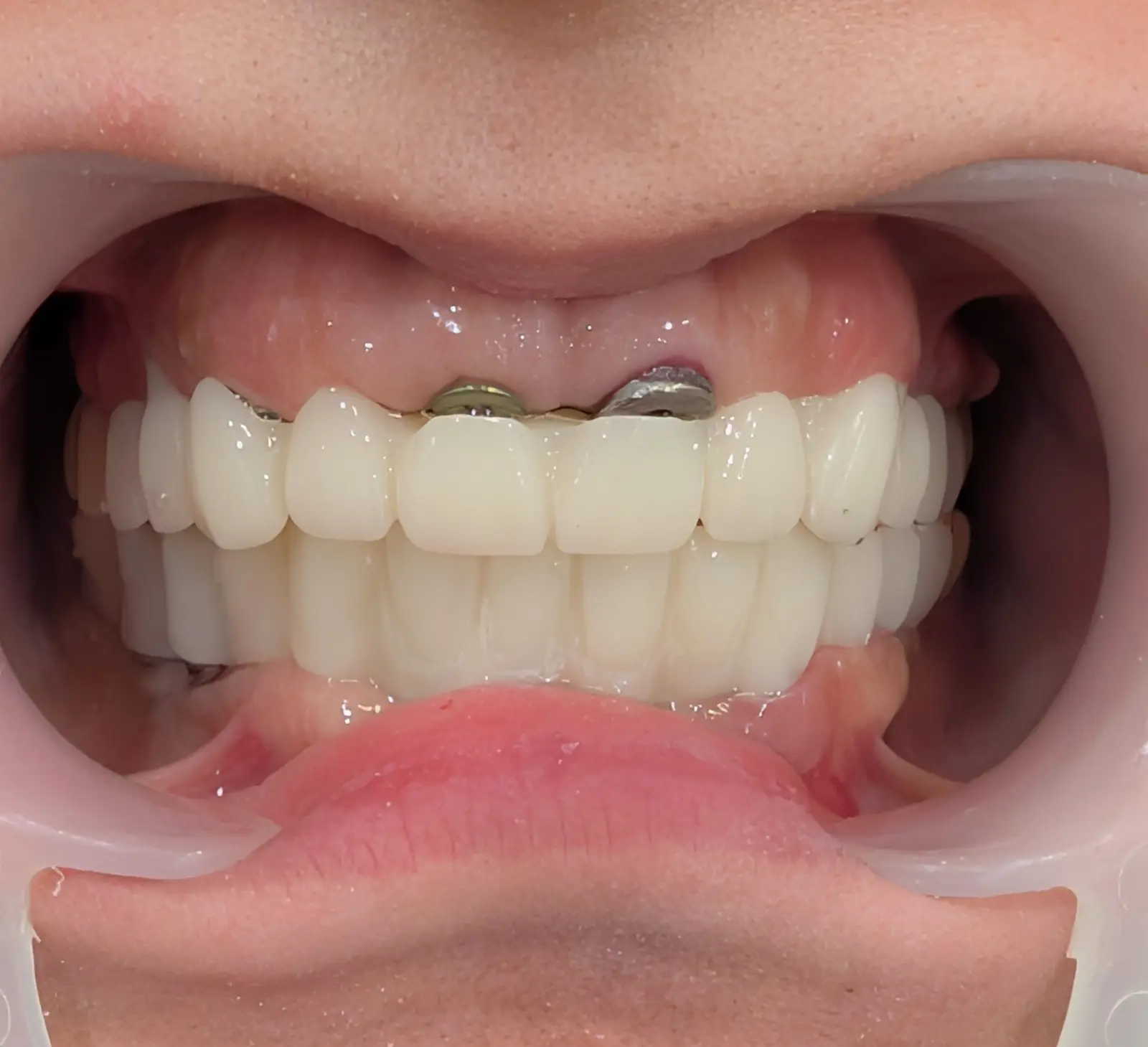
To control all of these factors, even though a few anterior implants were not yet ready to be scanned, I scanned the rest, fabricated a provisional PMMA for the whole arch, and delivered it on economy abutments. These provisionals were adjusted intraorally so that the occlusion, the incisal length, and the esthetics became exactly what we wanted.
Now the plan is this:
- To fabricate the posteriors as definitive restorations based on these very provisionals.
- To scan the anteriors separately once the situation is fully stabilized, and design them with a focus on the final esthetics.
That is, one arch remains provisional to serve as a guide, while the opposing arch — or part of it — becomes definitive. This is why I say my treatment resembled an adaptive cross-mount (Adaptive Cross-Mount) — a more practical, more personalized version of the classic concept.
Conclusion
Cross-mounting means maintaining the balance between precision and esthetics — a way for the final result to emerge from provisionals that have already been tested and adjusted. In this case, the provisional PMMA was not merely a transient stage, but the main pillar of the final design.
The content of this page is intended for the educational use of dentists and dental students.